

Hobbies and Interests
Have dreams?
We have 張愛玲的亂夢 and Robert Brownings's Bad Dreams.
Yearn to travel?
We have "Accidental Traveller" and "Package Tour - Spain and Portugal".
You find all at  .
.
Rendition by Kong Shiu Loon
INTRODUCTION
Poem Power
…John Turner, S.J. said in his Golden Treasure of Chinese Poetry, Chinese poetry is “the high artistic peak of the most literary, the most artistic, and the longest-established civilization that exists.”…
The Heritage
The earliest anthology of Chinese literature is the Book of Poetry compiled in the Sixth Century B.C. …
In 1953 the World Peace Council held an elaborate event to commemorate “the four greatest cultural figures in history to be remembered by the world”. Qu Yuan was one of the four. Since then, his poems had been translated into no less than fourteen languages. He became a poet of the world…
The Golden Era
The Tang and Song dynasties are the golden ages in Chinese history, with the greatest inventions, the fearless opening of the mind, and the most imaginative poetic and artistic expressions. …
Timeless Wisdom
Traditional Chinese poets all shared a unique understanding and outlook of life and the universe. In it heaven, earth and man are one, interdependent and mutually respectful…
…Chinese poets often communicate in transcendental ways, probably influenced by Zen Buddhism and the concepts of Laozi and Zhongzi, equating have to have-not, exalting the power of silence and space.
For the 21 Century
For readers like the lucky Wahyanites who know both Chinese and English, seeing the poems juxtaposed in two languages may help to inspire a deeper appreciation of their beauty and powers.
To read the rendition and the full Introduction, please click here.
 Mr Laurence Tam writes, "On 2nd May, Sunday, I was invited by the Hong Kong Culture and Leisure Services Department (LCSD) to be the judge of a sand sculpture competition at Shek-O Beach. Shek-O was chosen, because the sand over there is extraordinary fine. There had been 12 rounds of competitions before this. This was the final round in which five of the winning teams who scored the highest points in the earlier competitions were competing. The winning team in this competition will be representing Hong Kong to take part in the international sand sculpture event to be held in coming August at Kagoshima in Japan.
My Week in Guizhou - with the Guizhou Rose Society of Edmonton by Vincent Lee (65)
Background:
In the fall of 2009, I was looking for some kind of volunteer work that would allow me an opportunity to travel and to work in some dental or other capacity in a place where such services are needed - as long as it is not in a war zone (Doctors without Borders sometimes do that; I don't feel like working in an environment with bullets flying over my head!). I almost ended up going to Nicaragua around Christmas time 2009, but that didn't work out. And, because I couldn't go, I was able to attend a friend's Christmas dinner party, at which I ran into an old friend Dr. Chao Tai, a neurologist in Edmonton, who was originally from Singapore. His son, now also a neurologist, and my son, Sigmund, were high school classmates, and they learned music and piano from the same piano teacher. Much to my delight, I learned that for the preceding four years, Dr. Tai had been leading a group from Edmonton to do volunteer work in Guizhou Province (貴州省) in southwest China. I expressed my interest in joining his group, and ended up going with him for his fifth year into this remote part of interior China. Timing was perfect for me. After my Zhangjiajie tour, instead of returning to Hong Kong from Chengsha, I flew from Chengsha to Guiyang (貴陽), the capital city of Guizhou.
Guizhou Province, together with its neighbouring province Yunnan, is part of a plateau in southwest China (雲貴高原), with a range of elevations between 1000 to 2000 meters. It is hilly and wet, but the sandstone soil is of poor quality. I was told that only about 15 to 20 percent of its land can be used for agricultural use. Its capital Quiyang (貴陽) city is quite vibrant, though nothing like any of the coastal major centres. The province has a fairly well developed highway network amongst its major cities; but beyond that, the roads into the country side and villages are still narrow, and not well maintained. There are four major components to our group's visit: (1) The free clinic to villages; (2) Water projects to remote villages; (3) School visits, and (4) Visit to churches.
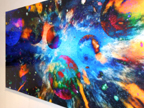 " ... I went to Shanghai to attend an opening ceremony of an art exhibition by a Hong Kong artist who held his exhibition at a new art gallery in Shanghai. The artist is Dr Dominic Lam, a Hong Kong Wah Yan 1965 graduate. He is the Chairman of World Eye Organization, and the inventor of a new form of painting known as 折光畫 or, painting by Chromoskedasic Process. It is this new form of painting that he is introducing to the Shanghai public. I believe that more such exhibitions by Hong Kong creative artists held outside Hong Kong will help promote the cultural image of Hong Kong.
(Click the images for the albums.)
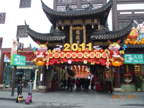 17th Feb was the Chinese Lantern Festival and the Festival celebration in Shanghai continued for a number of days. It was this Festival that made my short visit to Shanghai a specially colourful one. Our art exhibition opening ceremony took place in the evening on 18 Feb. On that day, we had the morning and most of the afternoon free. We spent the time visiting the Yu Yuan Spring Folklore Lantern Festival site.
 2011 年畢業金禧將到, 思緒戀戀母校, 波瀾漸興, 不可收拾, 故此就把回憶轉為五言句, 不敢言詩。為了求真, 用香港土本三及第文筆, 以求取到原汁原味, 重回五、六十年代少年的我、重拾當時的歡樂。- 余晃英 (1961年九華中五畢業)
  "Jesuits in Hong Kong, South China and Beyond: Irish Jesuit Mission – its development 1926-2006”
By Thomas J. Morrissey S.J.
2008 (832pp) ISBN 978-962-85883-7-4
Reviewed by Paul L. Lee, ’62 WYK
Click here to see more details.
 Many a times Wah Yan boys are quoted as not expressive enough. We intend to sit at the back ground and observe the happenings. Less expression will result in less communication. We want to communicate to all our members.
I take on this role to present my travel journal recently in Provence, France as a starting point to invite comments and conversation. Our website http://www.wykontario.org/ is for everyone to enjoy. The trip was shared by 3 families of class ’64 and during this short period, we experienced the sense of togetherness all over again. It was a warm feeling and I could not thank them enough for providing me with the opportunity. (by David Wong)
Click here to read more........